The “King Tut” Show in Los Angeles
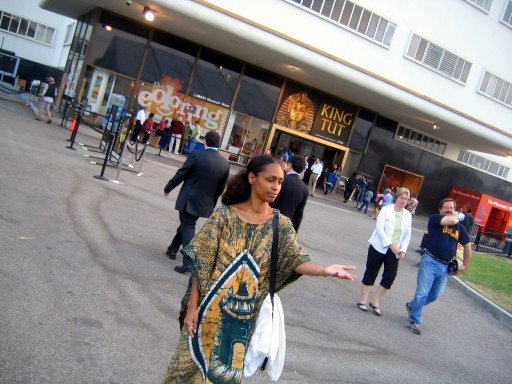 My dear mother wanted to take us all to the exhibition at the museum here in Los Angeles. She wanted to provide a similar childhood experience for my children that I had when I saw “King Tut” back in 1979. You may conclude that, by the manner and attire of my partner (shown at left), the thrill of seeing “King Tut” is gone for us. We did it for the “kids.”
Back in 1979, I was not convinced that “King Tut” had nothing to do with me and my childhood concept of not being European. In fact, I had a strong idea that I was not European as a child. This may seem strange to take the time to explain to 21st-century readers that a person with strong African features does not regard himself as European but we need to research, say, the psycho-social landscape under hair-care products designed for adult “African-Americans” of the last century to remind ourselves of why this explanation is necessary. So when I went to see “King Tut” back in 1979 it was like going to a funeral of a distant relative. I was charged with the fear and curiosity any child has when they go an elderly relative’s funeral.
 Here in the 21st century, I am still convinced that “King Tut” is related to me. When I see his stuff now, it’s more like going to an elaborate prison house where the effects of the deceased are stored by the jailors—who adeptly and subtly insist that these items relate to them. No: the library of Alexander certainly belongs to Alexander the Greek—but the contents of that library were not of his dominion. And so, without even meeting most of you, who have the “misfortune” of reading this Blog entry (even this part here), here are some highlights of the non-conflict between you and me:
- I say that the Greek concept of utopia came from Africa and they knew they could never be a part of it. So they were destructive in spite of themselves—just like the patriarchal invaders before them. You say, “That’s ridiculous” and you take a glass of big champagne and laugh “Ha. Ha. Ha. Ha.”
- I say, Homer is “ridiculous” when he writes that your god “Zeus” crossed the stream of “Oceanus” to dine with the “Excellent Ethiopians.” In the old days, they were called “Excellent Ethiopians”—today one U.S. soldier too many calls them “skinnys.”
- I say that Egypt is in Africa. You say that Egypt is in the “Near East.”
- You say, “Look at the Egyptians now! They don’t look like you.” I say, ‘Look at the population of Montana now! They don’t look like the people who were there before the birth of Columbus.’
- You say, “You may have relatives in West Africa and that’s no where near Egypt.” I say, ‘You may have relatives living in Prague but I bet I can find a Roman centurion or a Hun in your family line.’
- You say, “The world of King Tut was no utopia.” I say, ‘Correct. The Eden of the Old Kingdom had fallen long before the time of his birth. And egocentrism and imperialism was born in Africa when the sons of God lay with the daughters of men—men of Babylon, foreign patriarchs, now infused with Holy blood. When you see an ancient Egyptian with the foreign horse, flying on Assyrian wheels—that of the chariot—the end has come and New World Order is here.’Of course your desire is to represent the voice of “reason” in our “exchange” and you are certain that you do not know what I am talking about—and because you cannot understand what I am saying you console yourself that what I am saying is stupid (because how can someone like me understand something you cannot understand?). The end. Bryan is crazy. Flip Bozo bit. But remember: only an empire can contain so many Bozos. People relating directly to the natural world must come correct or perish. You don’t work; you don’t eat. In an empire, Bozos can always hustle up a meal. The centurions hand out free bread to the children of the captives, the human booty, before the games at the coliseum. Welfare State, Version 1.0—it’s a motor-booty affair.
We must not underestimate the power of cultural influence. There are Chinese kids in Beijing playing guitar like Jimi Hendrix and trying to sing like Ray Charles—and these great minds never respectfully comes to their mind by face and name—no matter how many museums Paul Allen builds.
Comments
King Tutankhamon, 2007-03-04 02:21:58
I attended the exhibit in Los Angeles, CA. It was like going to a funeral, when I saw my aunt Thuya's golden sarcophagus, and those trinkets buried with my past body. In Kemt, the "black africans" were from the south, Libya to the west, Arabia to the east, Crete and Greece to the north; they never respected our borders, kept invading, pushing them back. So we countered by Imperial conquest. This lasted and kept us "Egyptians" fed and clothed. If you wish to compare modern "africa" with Ancient "Egypt", don't. There is no "comparison", you are not us. We now reside in the Duat of Lord Osiris/Osirus. Come and visit us then?
Nebkheperura of United Egyptian Imperial-Republic, Duat.
rasx(), 2007-03-05 00:59:09
Tell me, "King," what is the word in your native language for "black africans." This may be difficult to display in Latin glyphs so you might have a link to an image file...?
And tell me how did the "Egyptians" of the Old Kingdom feed and clothe themselves without much significant contact with these poor (future) Imperial subjects for a few thousand years...?
You are correct: there is no comparison between "modern" Africa and ancient Egypt. It is an error to trust in the shadow of Egypt and worship the materialistic strength of Pharaoh.